


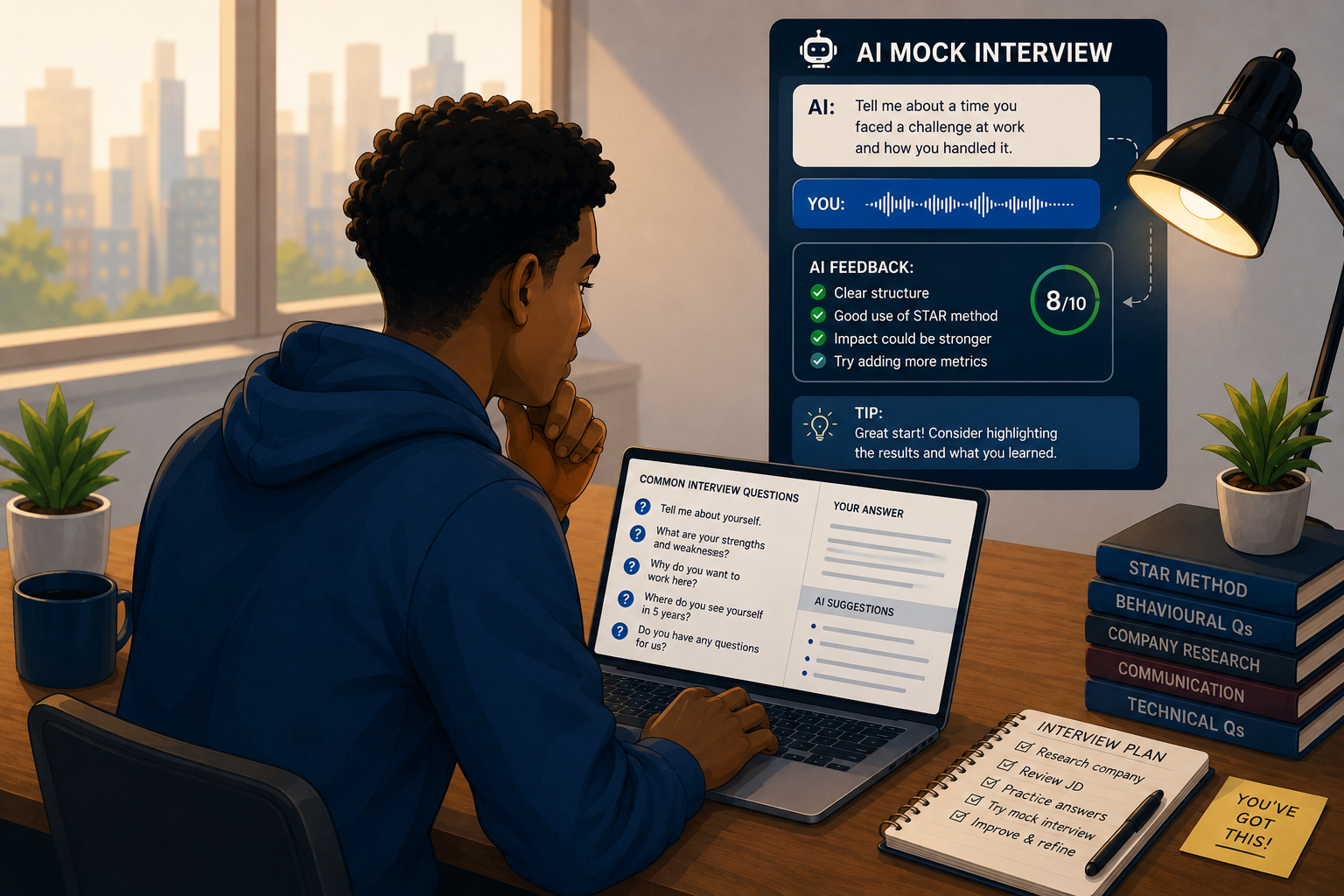
Getting the interview is only half the work. The other half is getting ready to explain your experience clearly, answer questions confidently, and not freeze up when something unexpected comes up. This guide shows you how to prepare for a job interview with AI, from anticipating likely and unlikely questions to running a full mock interview.
Most people prepare for interviews by reading generic tips online or rehearsing answers alone in their head. AI gives you something better: it creates a way to actually practise, get asked follow-up questions, and even get honest feedback on your answers before the real thing.
Why Use AI to Prepare for Interviews?
AI can’t know exactly what you’ll be asked. But it’s genuinely useful for:
- Generating likely interview questions based on the specific job description
- Helping you structure clear, confident answers (especially for behavioural questions)
- Running a mock interview that pushes back and asks follow-ups, as a real interviewer would
- Giving you honest feedback on where an answer is too vague, too long, or missing the point
Think of the system as a practice partner who’s always available and won’t get tired of running through your answers one more time.
Step 1: Get the Job Description and Company Context Ready
Before you prepare anything, gather the full job description, do some research and input anything you know about the company (what they do, their focus, recent news if relevant) and your CV or a summary of your relevant experience.
This context matters because generic interview prep (“tell me about yourself”) can only get you so far. The more specific information you give AI, the more targeted and useful its help will be.
If you haven’t built your CV yet, our guide on building a winning CV with AI is a good place to start first.
Step 2: Predict Likely Interview Questions
Paste the job description into AI and ask it to generate likely interview questions based on the role, both general questions and ones specific to the responsibilities listed.
You’ll typically get a mix of:
- Behavioural questions – “Tell me about a time you handled a difficult situation at work.”
- Role-specific questions – questions tied directly to the skills or tools mentioned in the job description
- Motivation questions – “Why do you want to work here?” or “Why this role?”
Step 3: Build Strong Answers Using the STAR Method
For behavioural questions, a clear structure helps you avoid rambling. The STAR method is a simple way to organise an answer:
| Letter | Stands For | What to Cover |
| S | Situation | Briefly set the context |
| T | Task | What you were responsible for |
| A | Action | What you actually did |
| R | Result | The outcome, ideally with a specific detail |
You can describe a real work situation to AI in plain language and ask it to help you shape it into a clear STAR-format answer.
For Example:
Instead of a rambling answer like:
“So there was this one time at my last job where a client was really unhappy, and I had to sort it out. It was stressful, but I think I handled it okay in the end.”
A structured version would look like:
“A client was unhappy with a delayed delivery. I was responsible for managing the relationship, so I contacted them directly, explained the cause, and offered a revised timeline with a small goodwill gesture. The client stayed with us and later renewed their contract.”
Step 4: Run a Mock Interview
This is where AI becomes especially useful when you prepare for a job interview with AI not just helping you prepare answers, but actually practising them out loud or in writing, the way a real interview would flow.
Ask AI to act as the interviewer for the specific role, ask you one question at a time, and respond to your answers with realistic follow-up questions the way a real interviewer might probe further.
This helps with two things:
- Practising your answers in a realistic back-and-forth, not just reading them off a page
- Getting used to follow-up questions, which is often where people get caught off guard
Step 5: Get Honest Feedback on Your Answers
After a mock interview or when reviewing a written answer, ask AI to critique it honestly. Useful things to ask for:
- Is this answer too long or too short?
- Does it actually answer the question, or drift off-topic?
- Is there a clearer or more specific way to say this?
- Does this sound confident, or does it sound uncertain?
Small, specific feedback like this is often more useful than generic “great answer!” praise, so be direct in what you ask AI to check for.
Prompt You Can Use
“I have an interview for this role: [paste job description]. Act as my interviewer. Ask me one interview question at a time, based on this role, starting with a general one and then moving into more specific and behavioural questions. After each answer I give you, respond with a realistic follow-up question, the way a real interviewer would. At the end, give me honest feedback on which answers were strong and which need more work.”
A Few Things to Keep in Mind
- Practise out loud, not just in writing. Reading a strong answer is different from saying it confidently under pressure.
- Don’t memorise word-for-word. Aim to understand the structure of your answer, not recite a script, memorised answers can sound stiff.
- Use AI to prepare, not to answer for you live. The goal is to walk in ready, not to rely on AI during the actual interview.
Conclusion
Interview preparation isn’t about guessing the exact questions you’ll be asked, it’s about going in with clear, well-structured answers and the confidence that comes from having actually practised them. Learning to prepare for a job interview with AI won’t sit in the interview for you, but it can be a genuinely useful practice partner in the days before.
Pair this with a strong, tailored CV, and you’ll walk into your next interview far more prepared than most.
If you want more support putting these AI skills into practice, our AI Bridge community covers exactly this kind of practical, everyday AI use, from job searching to workplace productivity.
